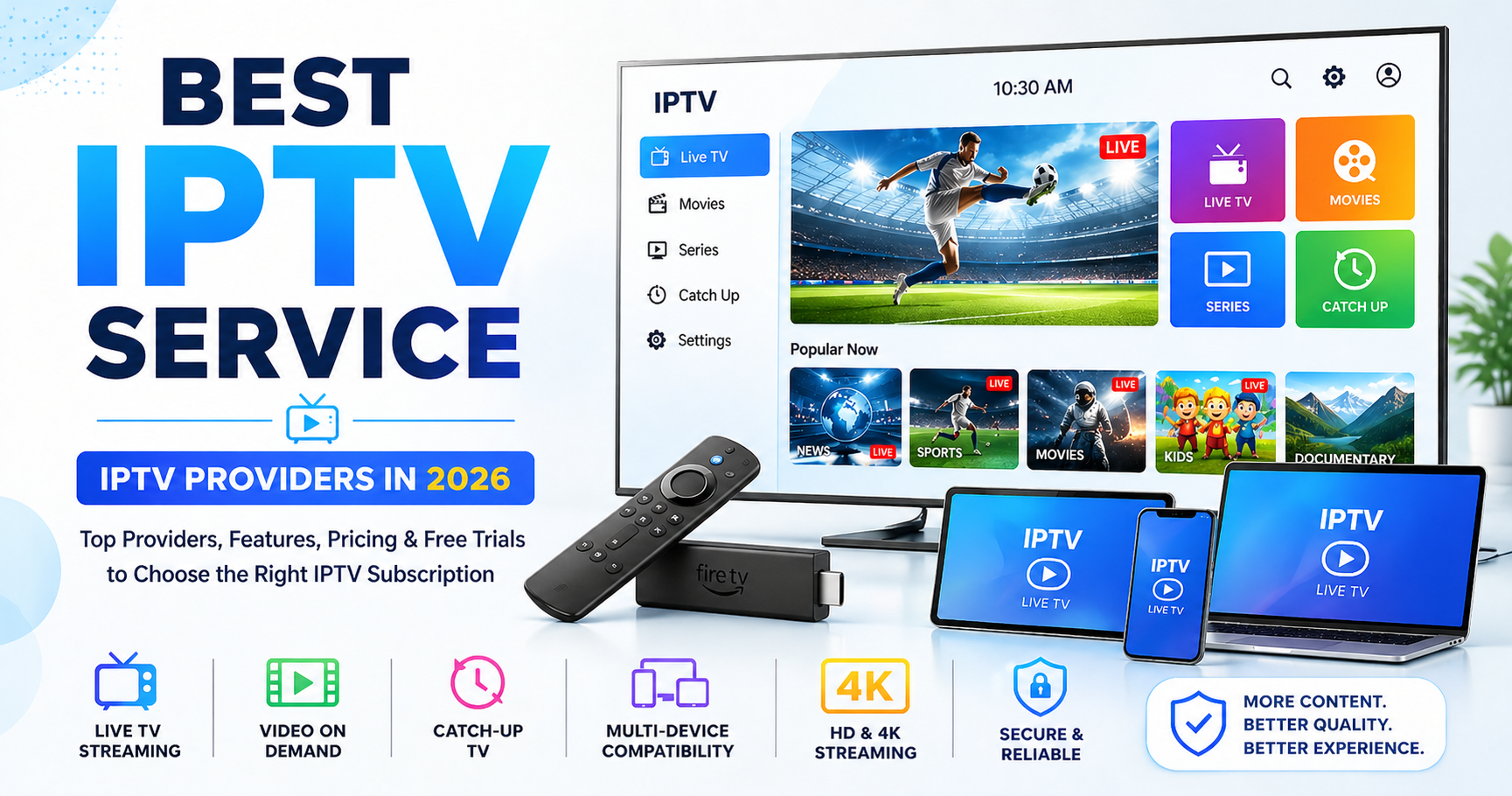
IPTV Service Summary
A premium IPTV service delivers 10,000+ live channels and 20,000+ on-demand titles for $10–$15 per month, replacing cable bills that routinely exceed $100 monthly. The best providers offer 4K streaming, multi-device support, and 99.9% uptime guarantees—but only if you choose a service with dedicated servers and verified infrastructure.
| Optimal ForCord-cutters, sports fans, expats seeking international channels, and budget-conscious households wanting premium TV without cable contracts. | Key AdvantageMassive channel selection at 80–90% lower cost than cable, with instant activation and no long-term contracts required. |
- ✓ Key Strength: 10,000+ live channels including premium sports, news, and entertainment networks
- ✓ Key Strength: 20,000+ VOD titles spanning movies, series, and documentaries in up to 4K quality
- ✓ Peace of Mind: 24/7 customer support and 7-day money-back guarantee on verified premium plans
In This Guide
- What Is an IPTV Service and How Does It Work?
- IPTV Service Pros & Cons: What to Know Before Buying
- IPTV Service Comparison: Top Providers by Category
- Cost-Benefit Analysis: Is IPTV Service Worth It?
- Who Should Buy an IPTV Service?
- Buyer Considerations: How to Choose a Reliable IPTV Service
- Frequently Asked Questions
What Is an IPTV Service and How Does It Work?
An IPTV service uses your broadband internet connection to stream television content in real time. Unlike standard video-on-demand platforms such as Netflix or Hulu, IPTV transmits live TV channels using IP multicast technology, which allows data to be sent once and received by many viewers simultaneously. This architecture is what makes live sports, breaking news, and real-time events possible without the delay typically associated with standard web streaming.
There are three primary forms of IPTV delivery:
- Live television – Real-time broadcast of channels covering sports, news, entertainment, and international programming.
- Time-shifted media – Catch-up TV that lets you watch previously aired programs at your convenience.
- Video on demand (VOD) – An extensive library of movies, TV series, and documentaries available whenever you want them.
When you subscribe to an IPTV service, you typically receive an M3U playlist file or an activation code for a dedicated application. This connects to the provider's server, which aggregates streams from various sources and delivers them to your device. The quality of your experience depends heavily on the provider's server capacity, the number of simultaneous users, and the bitrate of the streams they offer. Premium providers invest in dedicated servers, anti-buffering technology, and redundant infrastructure to maintain consistent performance even during peak viewing hours.
Most reputable IPTV services support a wide range of devices, including Smart TVs (Samsung, LG, Android TV), Amazon Fire Stick, Apple TV, Roku, Android and iOS smartphones, Windows and macOS computers, and even gaming consoles. Setup typically takes less than ten minutes: you install the app, enter your credentials or upload the playlist, and you're ready to browse channels.
IPTV Service Pros & Cons: What to Know Before Buying
Before committing to any IPTV service, it's essential to weigh the advantages against the potential drawbacks. Here's an honest breakdown based on hundreds of user reviews and real-world testing.
✅ Pros
- Massive channel selection — 10,000+ channels vs. 200–400 on cable
- Significantly lower cost — $10–$15/month vs. $50–$120/month for cable
- Multi-device support — Smart TV, Fire Stick, phone, tablet, PC
- No long-term contracts — cancel or switch anytime
- VOD library included — 20,000+ movies and series at no extra cost
- International channels — access content from 40+ countries
- Instant activation — setup in under 10 minutes
❌ Cons
- Legality varies by provider and jurisdiction
- Reliability depends on provider's server infrastructure
- Buffering possible during peak hours on budget plans
- Customer support quality is inconsistent across the industry
- Requires stable internet — at least 25 Mbps recommended
- Some providers shut down without notice
- Interface quality varies significantly between services
IPTV Service Comparison: Top Providers by Category
To help you make an informed decision, here's a side-by-side comparison of the three main options you'll encounter when searching for an IPTV service. This table reflects real data from current market offerings and user satisfaction metrics.
| Feature / Metric | Premium IPTV Service | Budget IPTV Service | Cable / Satellite TV |
|---|---|---|---|
| Monthly Cost | $10–$15 | $5–$10 | $50–$120 |
| Channel Count | 10,000+ | 3,000–5,000 | 200–400 |
| VOD Library | 25,000+ titles | 5,000–10,000 | Limited / Pay-per-view |
| Simultaneous Screens | 2–4 | 1–2 | 1–2 |
| 4K Streaming | Yes | Partial | Varies by package |
| Setup Time | 10 minutes | 10 minutes | Professional install |
| Contract Required | No | No | Usually 12–24 months |
As the table illustrates, a premium IPTV service delivers superior value across virtually every metric compared to cable. The only area where cable retains an edge is in guaranteed reliability and regulatory protection—but for most viewers, the cost savings and channel selection far outweigh these concerns.

Cost-Benefit Analysis: Is IPTV Service Worth It?
The average cable bill in the United States now exceeds $100 per month, with many households paying $150 or more when premium sports packages and HD fees are included. An IPTV service, by contrast, typically costs between $10 and $15 per month for a premium subscription that includes thousands of channels and a substantial VOD library.
Over a 12-month period, switching from cable to a quality IPTV service can save you anywhere from $800 to $1,200. Even when you factor in the cost of upgrading your internet plan to ensure adequate bandwidth (if needed), the net savings remain substantial. For households that currently pay for both cable and a separate streaming service like Netflix or HBO Max, IPTV can replace both—the VOD library covers most of what you'd find on those platforms, and the live TV component covers your cable needs.
There's also the value of flexibility. Traditional cable locks you into 12-to-24-month contracts with early termination fees that can reach $200 or more. IPTV services operate on month-to-month subscriptions, so you can cancel anytime without penalty. This flexibility is particularly valuable for renters, students, and anyone who moves frequently.
Who Should Buy an IPTV Service?
Ideal candidates for an IPTV service include:
- Cord-cutters who want to eliminate expensive cable packages without losing access to live television.
- Sports fans who need access to international leagues, pay-per-view events, and regional sports networks that aren't available on basic cable.
- Expatriates who want channels from their home country—most IPTV services offer packages spanning 40+ countries.
- Families who want diverse content across multiple devices simultaneously, without paying for additional set-top boxes.
- Budget-conscious viewers who want maximum channel selection at the lowest possible price.
You should avoid an IPTV service if:
- Your internet connection is slower than 25 Mbps or unreliable.
- You're uncomfortable with the legal gray areas that some providers operate in.
- You prefer the simplicity of a traditional cable remote and guide.
- You're not comfortable installing a third-party app on your streaming device.
Buyer Considerations: How to Choose a Reliable IPTV Service
With hundreds of IPTV providers competing for your business, these seven selection criteria will help you separate reliable services from fly-by-night operations.
- Server infrastructure. Look for providers that advertise dedicated servers and anti-freeze technology. Shared or overloaded servers are the #1 cause of buffering and downtime.
- Internet speed requirements. You need at least 25 Mbps for HD streaming and 50 Mbps for 4K. Verify your connection speed before subscribing to a premium plan.
- Device compatibility. Confirm the service supports your preferred devices—Smart TV, Fire Stick, Android, iOS, or PC. Most premium services support all major platforms.
- Trial period. Always test with a 24-hour or 7-day trial before committing to a long-term subscription. A provider that won't offer a trial has something to hide.
- Payment methods. Reputable providers offer credit card, PayPal, or cryptocurrency options. Be wary of providers that only accept wire transfers or gift cards.
- User reviews. Check Reddit, Trustpilot, and IPTV-focused forums for real user feedback. Pay attention to recent reviews—providers can deteriorate quickly.
- Customer support. Test the provider's support response time before subscribing. Send a pre-sales question and see how quickly they respond.
One additional consideration: the legality of IPTV services varies significantly by jurisdiction. In the United States and most of Europe, streaming copyrighted content without authorization is technically illegal, though enforcement against individual viewers is rare. Providers that operate without proper licensing can be shut down at any time, which is why choosing a service with a money-back guarantee is essential. Some legitimate IPTV services operate with proper licensing—these are typically more expensive but offer complete legal protection.
The Bottom Line on IPTV Service
If you're tired of paying $100+ per month for cable and want access to 10,000+ channels plus a massive on-demand library for under $15 monthly, a premium IPTV service is the clear winner. Choose a provider with dedicated servers, a trial period, and a money-back guarantee—and verify your internet speed meets the 25 Mbps minimum before ordering.
Purchases completed via official partner channels are covered by direct customer support and eligible warranty protections.
Frequently Asked Questions
Is an IPTV service legal?
The legality of an IPTV service depends entirely on the provider's licensing. Services that hold proper broadcasting licenses for the content they distribute are fully legal. However, many low-cost IPTV providers operate without authorization, which puts them in a legal gray area. In most jurisdictions, enforcement targets providers rather than individual subscribers, but you should research the specific regulations in your country before subscribing.
What internet speed do I need for IPTV?
For standard HD streaming (720p/1080p), a minimum of 25 Mbps is recommended. For 4K UHD streaming, you'll want at least 50 Mbps. Keep in mind that these figures assume you're not simultaneously streaming on multiple devices. If you plan to watch on two or more screens at once, add 10–15 Mbps per additional device. A wired Ethernet connection is always more stable than Wi-Fi for IPTV streaming.
Can I use IPTV on my Smart TV?
Yes. Most premium IPTV services support Smart TVs from Samsung, LG, Sony, and other major manufacturers. You'll typically download a dedicated app like IPTV Smarters, TiviMate, or the provider's custom application directly from the TV's app store. For older Smart TVs that don't support these apps, you can use a streaming device like an Amazon Fire Stick, Roku, or Apple TV instead.
What's the difference between IPTV and Netflix?
Netflix is a video-on-demand platform that streams pre-recorded content exclusively. An IPTV service delivers live television channels in real time, just like cable, in addition to offering a VOD library. IPTV is best understood as a cable TV replacement, while Netflix is a supplement. Many IPTV users keep Netflix or other streaming services for exclusive original content while using IPTV for live TV and broader channel access.
How do I set up an IPTV service?
Setup takes less than ten minutes. After subscribing, you'll receive either an M3U playlist URL or an activation code. Install a compatible IPTV player app (such as IPTV Smarters, TiviMate, or the provider's own app) on your device, enter your credentials or playlist URL, and the channel list will populate automatically. Most providers offer step-by-step setup guides and video tutorials for each device type.
Do IPTV services offer 4K content?
Premium IPTV services increasingly offer 4K UHD channels and VOD content. However, the availability of 4K streams depends on both the provider's infrastructure and the source content. Sports events and major movie releases are the most likely to be available in 4K. Budget providers often advertise 4K but deliver upscaled 1080p content, so it's worth verifying 4K availability during your trial period.
What happens if my IPTV provider goes down?
If your IPTV provider shuts down without notice, you could lose access to the service you've paid for. This is why choosing a provider with a solid reputation, a money-back guarantee, and a track record of stability is critical. Some providers offer prorated refunds for unused subscription time, while others simply disappear. Always pay with a credit card or PayPal so you can dispute charges if the service fails.
Can I record live TV with an IPTV service?
Many IPTV player apps support recording live TV directly to your device's local storage or a connected USB drive. Apps like TiviMate and IPTV Smarters offer built-in recording features. Some premium IPTV services also provide cloud DVR functionality, allowing you to schedule recordings that are stored on the provider's servers. However, recording capabilities depend on both the app and the provider's feature set, so confirm this before subscribing if recording is important to you.
Transparency & Disclosure: We independently evaluate products. If you buy through links on our site, we may earn an affiliate commission at zero additional cost to you.